Cape Town bioluminescence: red by day, glowing by night at Fish Hoek
We saw a red tide from False Bay on day one and asked our Simon's Town host to tell us if the sea lit up. Her friend's WhatsApp group came through, and we ended up on Fish Hoek beach watching the waves break blue.
Words Bhavya · · Updated
 Photo: Asher Pardey
/
Unsplash
The short version
If False Bay looks red or rusty by day and the evening is calm, go to Fish Hoek or Muizenberg after dark and kick the wet sand at the waterline.
We saw a red tide from False Bay on day one and asked our Simon's Town host to tell us if the sea lit up. Her friend's WhatsApp group came through, and we ended up on Fish Hoek beach watching the waves break blue.
What we'd actually do
-
Look at the sea in daylight. Red or rusty water on a calm, warm day is your cue to check the beaches that night.
-
Ask your host to pass on any word of a beach glowing, and join the Cape Town Bioluminescence group on Facebook.
-
Go once it's fully dark, keep torches and flash off, and kick the water at the edge. The plankton only light up when disturbed.
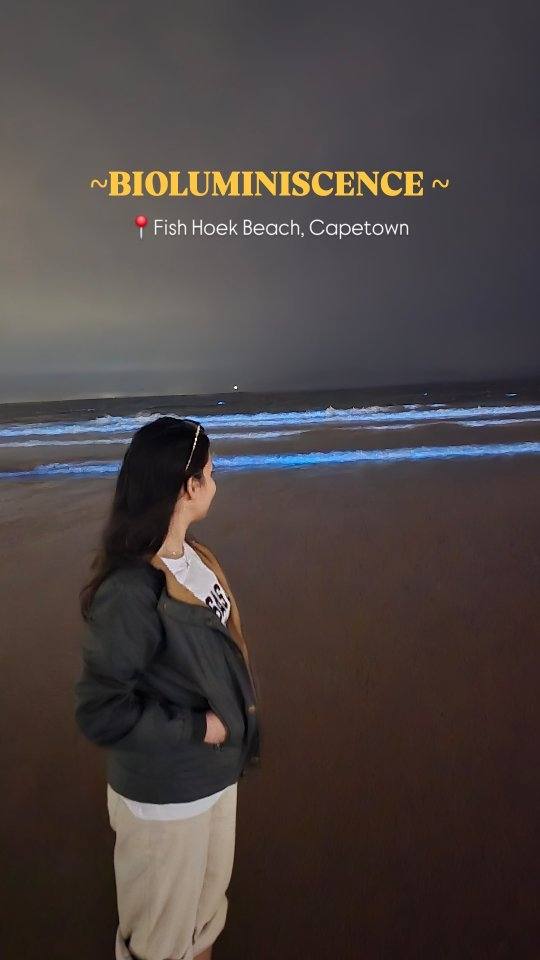
On day one we saw a red tide from False Bay. We’d read that red by day can mean glowing by night, so we asked our host in Simon’s Town to tell us if it happened. Then her friend’s WhatsApp group said Fish Hoek was glowing. We ran there and spent an hour kicking the sand like kids, with the waves breaking blue in front of us.
That glow is bioluminescence: plankton that flash when a wave or a foot disturbs them. In Cape Town it turns up on the False Bay beaches, from Muizenberg round to Fish Hoek and across to Gordon’s Bay, during a red tide on calm, warm nights, and a bloom usually lasts three to five days. Watching is free, and the first clue comes in daylight, from the colour of the sea.
What does bioluminescence in Cape Town look like?
Blue light where the waves break, and quick sparks in the shallows wherever something moves through the water. The cover of my reel is Fish Hoek that night: a grey sky, a dark beach and a few lines of blue along the surf. I’m in a jacket in it. Spring nights by the sea are cold if you’re coming from Hyderabad, and I lived in my puffer there.
Each cell glows only when it’s jostled, so the water lights up where a wave tips over or a foot lands, then goes dark a moment later. The way to see it is to walk the waterline and kick at the wet sand and the wash, which is how we spent our hour.
Where can you see bioluminescence in Cape Town?
On the False Bay side of the peninsula. We saw it at Fish Hoek. The Save Our Seas Foundation’s Shark Education Centre names Muizenberg, Fish Hoek, Gordon’s Bay and Kalk Bay as the beaches where people gather to watch, and EWN reported Clovelly, next to Fish Hoek, glowing in late August 2025.
Pick a sandy beach where small waves break close to shore. Fish Hoek is a good one. The beach is about 1.5 km long and quite flat, and the bay is protected from the stronger surf in the rest of False Bay, so you can walk the edge and splash in the shallows without much swell. From Simon’s Town it’s about 8 km by road, around 10 minutes in a car.
Blooms move, though. They tend to drift clockwise around False Bay with the currents and can sit in an eddy off Gordon’s Bay for long stretches, so check where people are seeing the glow that night before you drive anywhere.
When can you see bioluminescence in Cape Town?
EWN puts the likeliest window at late summer to early autumn, roughly February to April, once a red tide appears. The sea has glowed outside those months too: the sightings that made the news include Fish Hoek in October 2018, Muizenberg in January 2024 and Clovelly in late August 2025, and ours was in September. GroundUp, reporting on the Muizenberg bloom, said it’s expected at least once a year and lasts three to five days, so when you hear it’s happening, go that night.
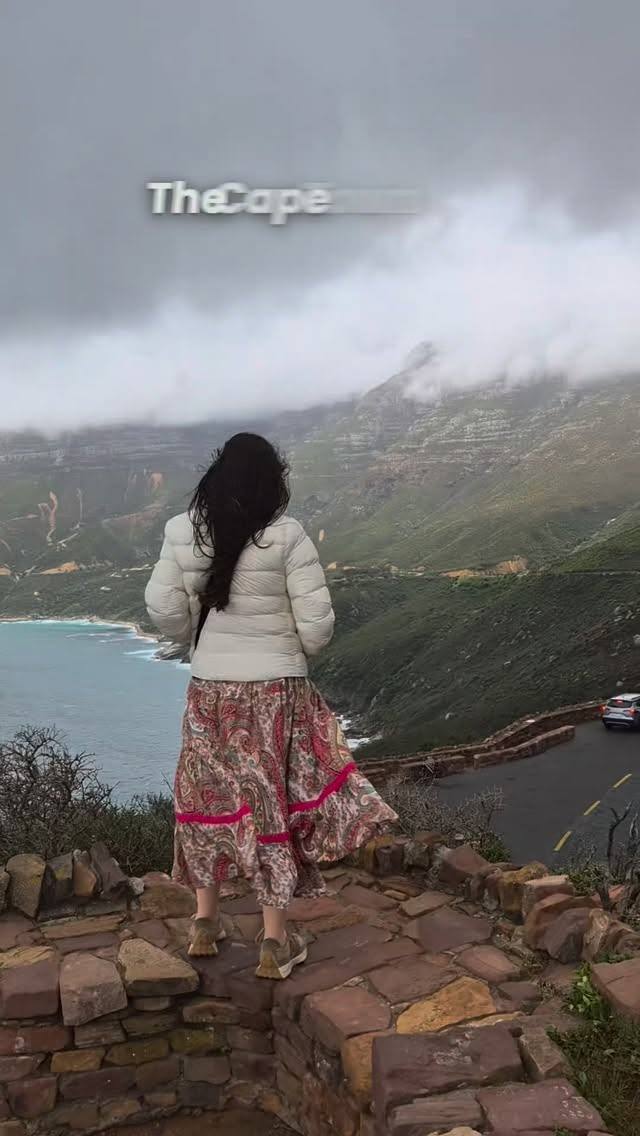
You want a calm, warm evening with little wind or swell, and Cape Town is windy. A pilot told me it’s the Mother City of Winds, and I didn’t believe it until my hair was standing on end 20 floors up. The windiest stretch runs roughly from September to March, so after a few blustery days, the first still, warm evening during a red tide is your best chance.
A dark, moonless night helps, according to the same EWN piece, but you don’t need one. Robyn Gwilt photographed Fish Hoek glowing in October 2018 under an almost full moon.
Go once it’s properly dark. In mid-September the sun sets at about 6:40 PM and the sky is dark by about 7:30 PM. In January the sun goes down around 8 PM, and it isn’t fully dark until about 9:30 PM.
“We ran there and spent an hour kicking the sand like kids.”
Why does a red tide by day mean glowing water at night?
The same plankton cause both. A red tide is a dense bloom of dinoflagellates, single-celled plankton that multiply fast in calm, warm water. In False Bay the glowing one is usually Noctiluca scintillans, often called sea sparkle. When a bloom is thick enough it tints the water red or rusty brown by day, and at night the same cells flash blue whenever something disturbs them. Inside each cell a compound called luciferin reacts with an enzyme, luciferase, in tiny structures called scintillons, and that reaction is the flash.
When Muizenberg lit up in January 2024, Dr Emma Rocke, a microbiologist at the University of Cape Town, told GroundUp she was almost certain it was Noctiluca, though she still wanted to check under a microscope. She said the algae glow when they’re agitated or rub against each other, and that if the red tide is visible by day and conditions hold, you’ll most likely see the glow that evening. That’s the rule we’d read about. Nobody put our night’s water under a microscope, so I can’t tell you which species we were kicking around at Fish Hoek.
Brown surf on its own isn’t proof. The brown water you often see in the breakers along the north shore of False Bay, Muizenberg included, is usually a persistent bloom of a harmless diatom, Anaulus australis, fed by groundwater seeping through the sand and by river outfalls. Treat a red or rusty tint as a reason to check the beach groups that night, and expect a few false alarms.
How do you know if the sea will glow tonight?
Watch the water by day, then ask people who live there. Time Out Cape Town says there’s no dedicated site for red-tide conditions: most locals watch beach cams, such as the one at Muizenberg, and check social media, including the Cape Town Bioluminescence group on Facebook. We had a host who knew we wanted to hear, and her friend’s WhatsApp group was what told us Fish Hoek was glowing.
If you’re staying near False Bay during a red tide:
- In daylight, look out over the bay. Red or rusty water on a calm, warm day is the signal.
- Check the evening forecast. You want little wind and little swell.
- Tell your host you’d like to know if a beach starts glowing, and join the Facebook group.
- After dark, check the group or the Muizenberg cam, then head to whichever beach people say is lit up.
- On the sand, switch your torch off and give your eyes a few minutes to adjust. Then kick at the water where the waves run up.
It worked the way the aurora did for us in Lofoten, where our hosts knocked to say the lights were out and we grabbed the car keys and drove. If you’ve done a northern lights chase in Norway or Finland, you know the drill: watch the conditions and leave the minute someone local says go.
Is it safe to swim in a red tide in Cape Town?
Paddle, but don’t swim. Noctiluca scintillans doesn’t produce toxins, and Dr Rocke called the 2024 bloom “completely natural”. The trouble is that “red tide” covers many species and some are toxic. Off South Africa’s west coast, blooms of Alexandrium catenella make shellfish poisonous to eat, and False Bay itself has a high incidence of dinoflagellate blooms, some of which produce toxins. From a dark beach you can’t tell which kind you’re standing in.
Skin irritation after swimming in a harmful bloom is commonly reported, so keep your head out of the water and don’t swallow any. NOAA notes that toxic blooms can make shellfish dangerous to eat, so leave the mussels on the rocks while the water is discoloured. Even a harmless bloom causes trouble as it dies off: the decay uses up oxygen in the water, and Noctiluca can also release ammonium. Either can kill fish. If dead fish are washing up, stay out.
Night swimming has its own risks. You can’t see a rip current in the dark, and they can form on the steeper stretches of the north shore between Muizenberg and Macassar. Water in the north of the bay ranges from about 13°C to 22°C over the year, and Fish Hoek’s lifesavers are on duty only in the summer peak season, so don’t count on anyone watching the water after dark.
How do you photograph bioluminescence on your phone?
Slowly, and with low expectations. The flashes are faint and brief and the water is black, so phones struggle to focus. Robyn Gwilt, who photographed Fish Hoek in 2018, told SA People: “It’s difficult as the water is so dark, so you have nowhere to focus.” She shot at a high ISO with a slow shutter and “a bit of guess work”, and the almost full moon helped.
On a phone, turn the flash off and ask the people near you to keep their torches off, because any light washes out the glow and resets your eyes. Rest the phone on a rock or your bag and use night mode, which keeps the shutter open longer. Video often works better than photos because the glow only appears when the water moves, so film the waves breaking or get someone to kick the water in the foreground. Then put the phone away for a bit and watch.
What does it cost to see bioluminescence in Cape Town?
Nothing. It’s a public beach with no ticket and no tour. The only spend is a bed close enough to get there fast, because a bloom lasts a few nights and the reports come in after dark.
| What | Cost | Notes |
|---|---|---|
| Watching the glow at Fish Hoek | Free | Public beach, no ticket. We stayed an hour |
| Our BnB in Simon’s Town | Under ₹5,000 | The cosiest space, and views when you step out |
| Simon’s Town to Fish Hoek | Fuel, or a short Uber | About 8 km, around 10 minutes by road |
| Boulders Beach the next morning | SANParks conservation fee | Fees changed on 1 November 2026, so check the current rate |
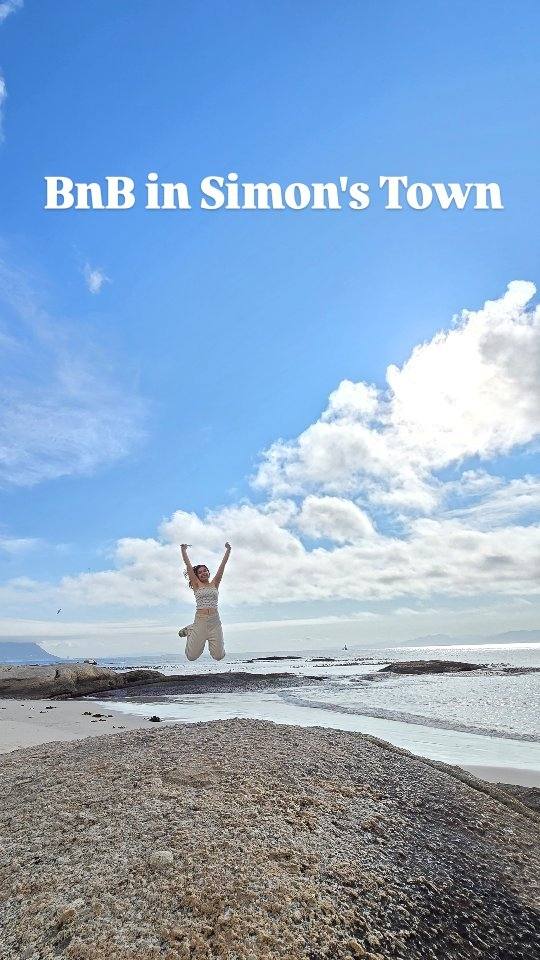
Staying in Simon’s Town is what made it work. We were 10 minutes from Fish Hoek, with a host who knew to tell us, instead of in the city about 40 km away by road. The BnB, Boulders and the rest of our time there are in our Boulders Beach and Simon’s Town guide, and there’s more on the town itself on the Simon’s Town page.
What else is there to do near Fish Hoek?
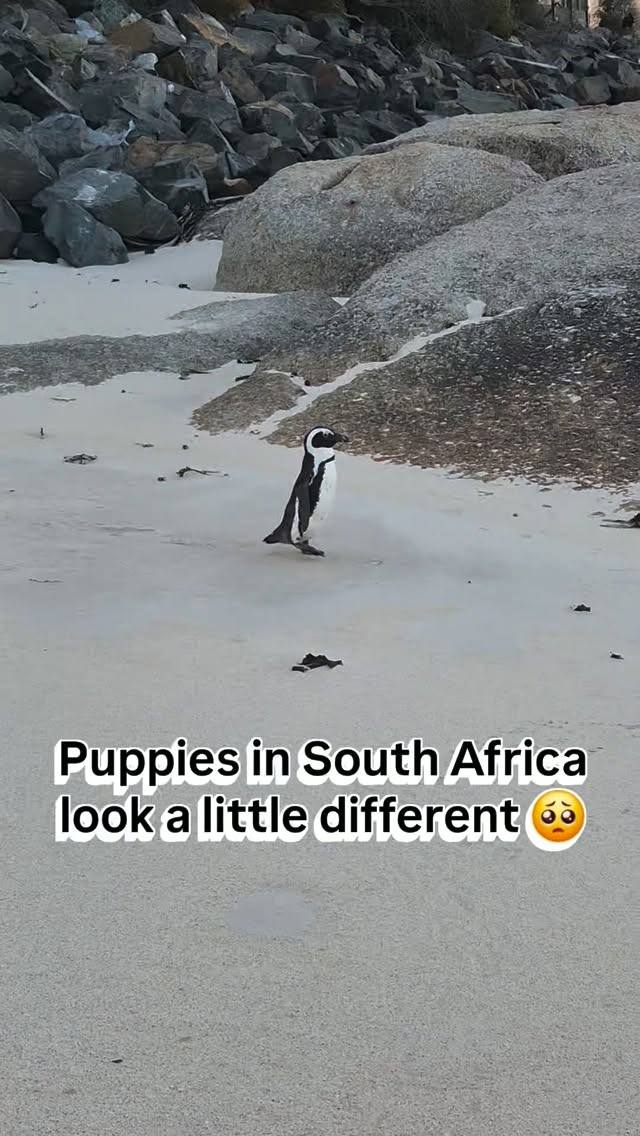
Go and see the penguins. Get to Boulders Beach in Simon’s Town for the 8 AM opening, when the light is soft and the crowds are thin; opening times shift with the season, so check yours. Do the boardwalk, then walk over to the beach side, because one SANParks ticket covers both. The African penguin is now classed as Critically Endangered, so no touching and no feeding. Penguins wander about freely on Seaforth Beach next door too, and that’s where I saw the cute bunch in the second reel below.

If it’s your first time in the city, read Cape Town travel tips for first-timers for the wind, Table Mountain and Chapman’s Peak, and South Africa in September for the weather. My packing list for September to November is short: a jacket and an umbrella, summer clothes as well, and a hair tie, because the wind here has no mercy.
Skip it
Swimming in it. The plankton that usually make False Bay glow aren't toxic, but some red-tide species are, and you can't tell them apart from the beach. Paddle, and leave the mussels on the rocks.
Questions people ask
When can you see bioluminescence in Cape Town?
EWN puts the likeliest window at late summer to early autumn, roughly February to April, but you can't plan a date around it: the sea has glowed at Fish Hoek in October, Muizenberg in January and Clovelly in late August. A bloom usually lasts three to five days. We saw ours in September.
Where is the best place to see bioluminescence in Cape Town?
The False Bay beaches. We saw it at Fish Hoek, and Muizenberg, Clovelly, Kalk Bay and Gordon's Bay have all had sightings. A sandy beach with small waves breaking close in shows it best.
Is it safe to swim in a red tide in Cape Town?
Paddle, but don't swim. Noctiluca scintillans, the plankton that usually makes False Bay glow, doesn't produce toxins, but other red-tide species do and you can't tell them apart by eye. Don't eat shellfish collected during a bloom.
How do you know if the sea will glow tonight?
Look for red or rusty water by day and a calm evening. There's no official tracker, so locals watch the Muizenberg beach cam and the Cape Town Bioluminescence Facebook group. We heard through our host's friend's WhatsApp group.
Can you photograph bioluminescence on a phone?
Yes, but it's hard. Turn the flash off, rest the phone on something steady and use night mode or video. A photographer who shot Fish Hoek glowing in 2018 used a high ISO and a slow shutter.
Know before you go
- Best time
- Calm, warm nights during a red tide. Likeliest February to April, but it has glowed in January, August, September and October
- Budget
- Free to watch (our Simon's Town BnB was under ₹5,000)
- Time needed
- An hour on the beach after dark
- Getting there
- Fish Hoek is about 8 km, or 10 minutes, by road from Simon's Town
What we checked · November 2026
- Time Out Cape Town: Weird and wonderful things about the ocean (Christy Bragg, 7 June 2026; no dedicated red-tide site, Muizenberg beach cam, Cape Town Bioluminescence Facebook group) timeout.com
- GroundUp: In photos, beautiful bioluminescence at Muizenberg (Ashraf Hendricks, 16 January 2024; Dr Emma Rocke, UCT) groundup.org.za
- Save Our Seas Foundation Shark Education Centre: Red tide on our doorstep (6 October 2025; Noctiluca in False Bay, Muizenberg, Fish Hoek, Gordon's Bay, Kalk Bay) saveourseas.com
- EWN: Cape Town beaches glow blue, leaving beachgoers in awe (8 September 2025; Clovelly in late August 2025, calm warm nights, February to April) ewn.co.za
- SA People: Fish Hoek resembles Avatar scene as bioluminescence moves in (24 October 2018; photographer Robyn Gwilt) sapeople.com
- Wikipedia: Noctiluca scintillans (no toxins, ammonium, luciferin-luciferase reaction in scintillons) en.wikipedia.org
- Wikipedia: False Bay (dinoflagellate blooms, clockwise drift and Gordon's Bay eddy, Anaulus australis, north-shore water temperature, rip currents between Macassar and Muizenberg) en.wikipedia.org
- Wikipedia: Red tide (Alexandrium catenella off South Africa's west coast; skin irritation after swimming during a bloom) en.wikipedia.org
- NOAA National Ocean Service: What is a red tide? oceanservice.noaa.gov
- Wikipedia: Fish Hoek (beach about 1.5 km and quite flat, sheltered bay, lifesavers in summer peak season, about 40 km by road to Cape Town) en.wikipedia.org
- OpenStreetMap (OSRM): driving route, Simon's Town to Fish Hoek Beach, 8.1 km, about 10 minutes openstreetmap.org
- timeanddate.com: Cape Town sunrise, sunset and twilight, September 2026 timeanddate.com
- timeanddate.com: Cape Town sunrise, sunset and twilight, January 2026 timeanddate.com
- SANCCOB: African penguin newly classified as Critically Endangered (28 October 2024) sanccob.co.za


